
Our history in Claypole (Province of Buenos Aires, Argentina) is repeatedly marked by the same image: the San Francisco stream overflowing after heavy rain, advancing through the streets, entering homes, and reminding residents that water-related and sanitary risk is part of everyday life. For years, the community lived with these overflows, until in 2018 we achieved the widening of the stream bed as a palliative measure to mitigate flooding. That is how Proyecto Hábitat Claypole was born.
From that moment on, we were clear that our goals were to reduce flooding, protect and restore aquatic and terrestrial biodiversity, and study the dynamics of the stream in order to have influence on the management of urban waterways in Buenos Aires. Today, thanks to the ORA fellowship and an alliance with the Polo Técnico de Izquierda, the National Water Institute, and the Faculty of Exact and Natural Sciences at the University of Buenos Aires, we have taken a few more steps along that path.
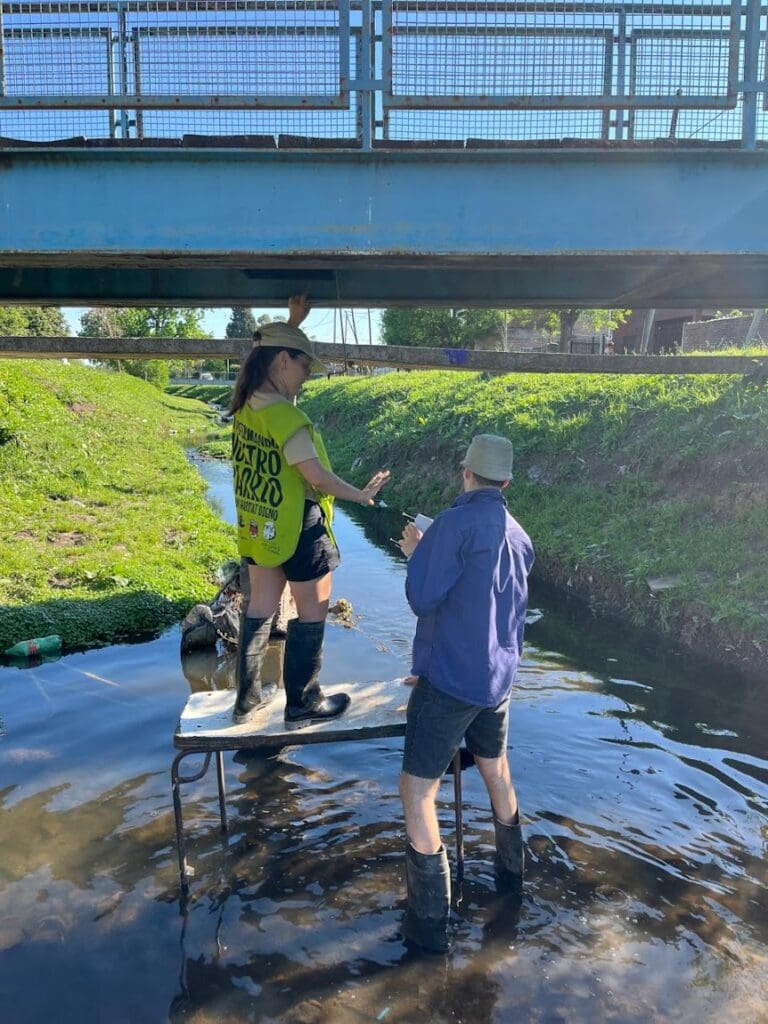
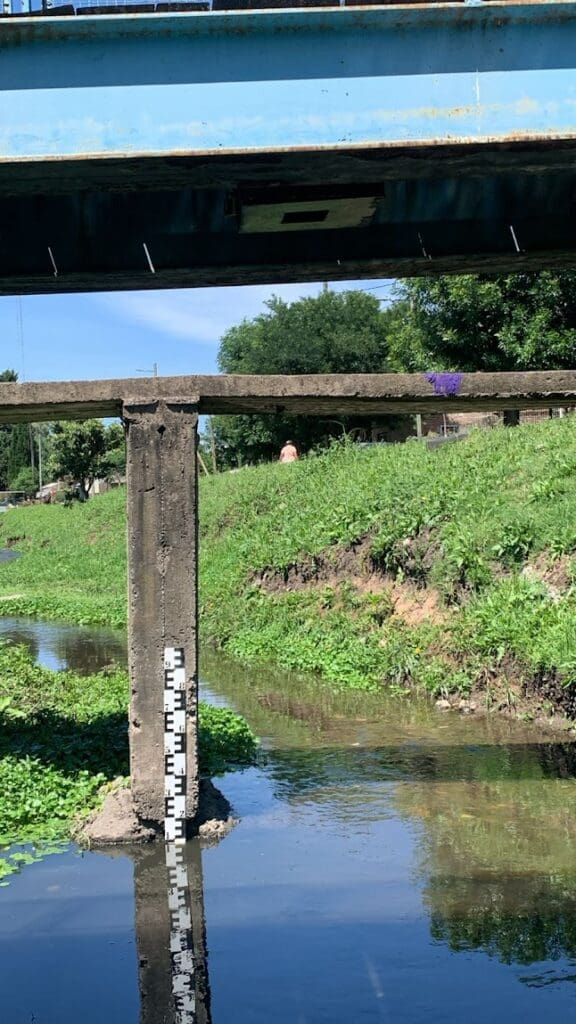
Recently, we designed, installed, and began monitoring a community-based water-level sensor and a staff gauge visible from the riverbank. It may seem like a minor, almost technical action, but it is the first time that systematic records have been generated in this working-class neighborhood and on the San Francisco stream about what the stream does every day.
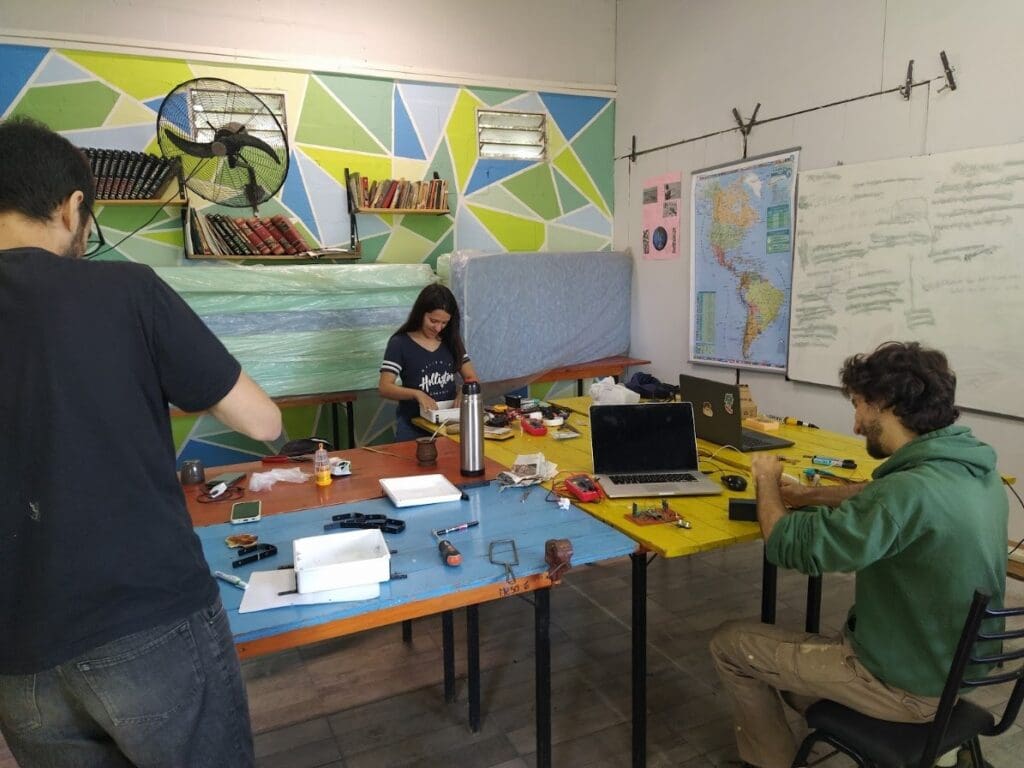
We had been thinking about this project for some time in various assemblies of Proyecto Hábitat Claypole at the Galpón Cultural, part of the social organization that hosts us. Before installing the sensor, we walked along the stream and looked for a point where the cross-section was stable, where the structure would not disappear in the next heavy rain, and where access would be safe for maintenance. The installation itself was a mix of workshop, community workday, and experimentation: we set up the sensor connected to a data logger and later installed a staff gauge to enable participatory monitoring as well. When we recovered the first data—when we saw the first numerical reading—the stream began to speak to us in a new language.
These data will allow us to design Green infrastructure strategies using accurate local data on the stream’s dynamics. Hydrological monitoring is also combined with processes we are advancing through the project: planting native riparian vegetation grown in our community nursery; restoring ditches to improve drainage and reduce the pollution entering the stream; and planning small-scale ecological restoration interventions. What we measure with the sensor helps us decide where it makes sense to strengthen vegetation cover, how water moves during heavy rain, or which areas need clearing or redesign. In this way, technical information becomes a practical tool to guide concrete actions.
The ORA fellowship not only made it possible to acquire materials and move forward with the purchase of more robust sensors, but also to sustain time for meeting, walking, and collective reflection. It is in these spaces that the project’s deepest meaning emerges: building resilience is not only about having data, but about creating an urban laboratory where neighbors, social organizations, and researchers can imagine solutions and put them into practice. Claypole is a territory shaped by inequality, but also by enormous community strength. Our work is rooted there, seeking to expand local capacities to face a more uncertain water future.
To understand, anticipate, and transform. And that transformation—built step by step from the ground up—is perhaps the most valuable contribution this experience is leaving us.
About the Author
ORA Latin America Fellow Martín Graziano is an Argentine biologist, educator, and territorial activist who bridges academic research and grassroots environmental action. A professor at the University of Buenos Aires and researcher at CONICET, he works closely with popular movements to develop community-led tools for water justice and ecological restoration. Through Proyecto Hábitat Claypole, he and his collaborators are restoring the San Francisco Stream using participatory monitoring, native plant cultivation, wetland regeneration, and popular education—advancing a more just, community-rooted ecological future. Learn more at folweb.com.ar and follow @proyectohabitatclaypole on Instagram.