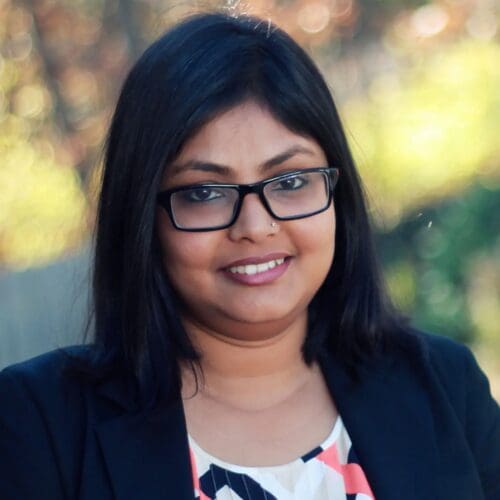
Urmitapa Dutta, Ph.D. is leading two ORA Research Grants, including Storytelling as Survival: The Itamugur Community Media Initiative for Miya Rights and Recognition as well as a project to understand the narratives of culture and the arts that exists within community-based projects within the larger ORA community.
Urmitapa Dutta is a community psychologist, scholar-activist, and educator whose work is rooted in transnational feminist and decolonial frameworks. She is an Associate Professor in the Department of Psychology at the University of Massachusetts Lowell, where she also serves as the Chair of the UMass Lowell Greeley Peace Scholar Program. Her research and praxis are deeply informed by long-standing commitments to resisting structural violence and amplifying community-based knowledges as sources of radical imagination and transformative justice.
Raised in the Northeastern borderlands of India and now living in the U.S., Urmitapa brings a transnational consciousness to her work—navigating and interrogating power across borders, identities, and academic spaces. Her scholarship centers the everyday experiences of marginalization and resistance, particularly as they emerge through intersecting structures of oppression. She has collaborated with community organizers, artists, and activist collectives across India, U.S., and South Africa with a focus on co-creating liberatory knowledge and fostering spaces for collective healing.
Urmitapa is recognized for her expertise in decolonial, participatory, arts-based, and narrative research methodologies. Her work pushes methodological boundaries by integrating critical qualitative approaches that are grounded in relational ethics, epistemic justice, and solidarity praxis. She frequently engages in transdisciplinary, community-driven research that foregrounds lived experience, intergenerational storytelling, and creative expression as vital forms of knowledge production. Her long-standing partnerships with indigenous and other persecuted communities in Northeast India exemplifies this praxis: together they have co-produced research and art that foregrounds the creative strategies these communities use to navigate dispossession, gendered violence, and ecological precarity. Her scholarship also critically examines how community psychology can be reimagined through solidarities across the Global South in ways that refuse colonial legacies of knowledge production. Her co-authored works with community partners and students have appeared in Qualitative Inquiry, American Journal of Community Psychology, Journal of Peace Psychology, and the Journal of Social Issues and several decolonial community psychology handbooks.
As an educator, Urmitapa is deeply committed to co-learning pedagogies that challenge dominant epistemologies and nurture students’ capacities for critical consciousness and social transformation. She works to create classroom spaces that honor embodied knowledge, dialogue, and relational accountability. She mentors students—particularly those from first-generation, immigrant, and BIPOC backgrounds—who are seeking to build liberatory lives and research in service of justice.