Contents
Introduction: Radical Interconnectedness
1. Who Is “We”? Kinship with the World
2. The Way Over and Back: Perspective After Migration
3. Care of Place: Rooted Practices of Territorial Care
4. Identities in Relation: Beyond Our Own Humanities
5. The Unnamed: What Lies Beneath the Surface
6. Telling the Story: Narratives, Framing, and Language
7. Rooted Action: From Worldviews to Practice
Conclusion: Integration for Re-Existances
Unfolding Paths: Further Research
Introduction: Radical Interconnectedness
We live in times of crisis. Climate instability, biodiversity loss, water stress, and deforestation are wounding the world we live in. They are also shaping the way we think, feel, and live our lives. As these crises intertwine and intensify, the human experience is becoming increasingly fragmented. The crisis of imagination, attention, and emotion has led to an all-time peak in loneliness, depression, and despair. At the same time, the rise of authoritarian politics, artificial intelligence, economic precarity, and technological disruption have reorganized our cognitive connection to society. The ecological crisis has not retreated; it has become profoundly entangled with everything else.
In this context, catastrophic environmental narratives are losing their potential for mobilizing people. The language of emergency and alarm remains accurate, but fact-checking does not seem to be leading to action nor change. For many people, that narrative has become something to avoid: they already have too much of it, and perceive that nothing can be done. It has become more and more difficult to translate the emergency into specific decisions, commitments, or collective forms of response. The question, then, is not only the scale of the crisis, the sense of urgency, but how to reclaim the capacity to act and create new ways forward. And the ORA community offers some very specific answers.
None of these projects sprout from an abstract idea. They grow from diverse territories and practices. They emanate from rivers and forests, from art spaces and spiritual memory. Roadmaps filled with communal care that remains rooted in place even when physically separated from its origin. Projects that present concrete practices of re-existences and alternative pathways, growing from persons with profoundly ecological worldviews. They are able to shape different ways of sustaining life, stewarding, healing and repairing relations with both nature and the social fabric. Action that is able to fill with creative alternatives the fractures of the present.
The urge to change the world tends to dazzle with its aspirational scale. The challenge is to deem politically possible what is ecologically necessary. The projects within the ORA Community successfully manage to translate this into action through organization, communication, and daily practices.
Many communities are already living inside relational ways of being, where everything is intrinsically interconnected. For people who have not grown within these worldviews, this relational way of being is challenging to integrate, even to understand. Learning this relationality seems to invoke actions that create powerful responses to the polycrisis. Taking the step of implementation is, however, still a challenge even for communities whose cultures have relationality at their core and are eager to learn how to form other relationships with the natural world.
Even under the acknowledgment that many insights and learnings would be left out of this piece, we write this essay with the hope that the project’s visions and our own interpretations of them can travel without being flattened. We hope that leaders, communities, and organizations find in them ways to incorporate and expand their responses to the polycrisis. Not as universal models to be copied, but as specific frameworks that help us ask better questions: How big is the extent of our “we”? Who is included in it and how can we turn these stories into rooted action? What is the power of the underlying energies that bind us all? And how exploring these different senses of being with the natural world can become ways of working, organizing, and building futures?
[ Back to top ]
Methodology
This research began with one question: How do people who respond to the polycrisis through action understand ecology? Very early in the process, we understood that the word “ecology” itself would have very different meanings for different people. Shortly after, a variety of possibilities arose: home, our kin, our guide, a territory, a system, or field of struggle. How do these understandings shape the way people act, their work and responses to the polycrisis?
The project required the ability to connect climate, environmental, and ecological analysis with intercultural conversation, narrative interpretation, and artistic sensibility. Looking for insights, language presented as both a barrier and an intercultural mediator that had to carry meaning through metaphors, memories, and stories. Insights would not come up as direct arguments or straight up information.
This essay draws on 12 interviews with ORA Fellows across Latin America, India, and Africa. They were semi-structured, giving way to a variety of conversations and themes depending on the interviewee. The approach was qualitative, prioritizing depth and relationality. The methodology included aspects of grounded theory research. Despite having initial hypotheses, the questions evolved throughout the interviews as each iteration informed the next.
The interviews were designed to read patterns, themes, and stories around a central idea: How do people translate relationships with the natural world into their practices? The way someone understands the natural world encompasses their life philosophy, cosmovision, and other elements of their identity. Fellows joined a conversation about their sense of the natural world, an invitation to let themselves be seen as who they are in relation with the world. The findings below should therefore be read as frameworks in formation: not universal models, but situated logics that can inform broader ecological, cultural, and political work.
Some conversations leaned more heavily into conceptual reflection, while others were shaped by storytelling or concrete examples. This was a key source of insight into how narratives are formed, how they are put to work and what subjective aspects are at play. Building trust was also important in allowing for this information to emerge—as was coping with the challenge of the time constraints of a one-time interview.
Interviews were complemented by a review of documentary and media materials of each fellow’s work, including campaign assets, websites, and internal documents when available.
Throughout the process, sessions to interpret interviews and initial insights were held by the research team, taking a step further by engaging in activities where some of these insights could be put into practice. What we heard throughout the interviews also became a part of the researchers’ own relationship with our work and experience. Along the process, our own notions and worldviews around the natural world have been profoundly shifted and transformed. Far from carrying this process as a mere “objective” and neutral experience, our own understandings have been at play, and we understand that our own experiences and beliefs have also been a key source for our research and pathway and therefore permeated our work. Throughout the essay we expect to reflect this approach, including direct references to how our own subjectivity has come into play and what conclusions are impressions rather than findings.
This methodology reflects the project’s premise: compelling and fecund ecological narratives are neither fixed nor devoid of the context in which they are produced. They arise from situated practices that require engagement, interpretation, and care.
[ Back to top ]
Learnings
Drawing upon the previously outlined research approach, our conclusions seek to preserve the diverse, complex, and situated nature of different experiences. This essay grows from ideas generated in this exchange. It seeks to be true to the stories, insights, and projects in response to the polycrisis.
Each of the following sections helps us understand what is at work in these projects that create powerful responses to the polycrisis. They are separated into five learnings, which are correlated and overlapped: They reflect our subjective approach and attempt to identify the bright and luminous points that, ultimately, create a constellation of encounters.
Our research created ripples that expanded far beyond the conversation itself. As we analyzed and organized what we’ve heard and learned, we looked towards other writers and books, reached out to different conceptual universes, which included songs and poems that helped us understand and relate to what was unfolding before us. These can be taken as direct references for where to delve into the path where the learning resonated. We’ve called these “cultural echoes,” grouping works that resonated with the insights and emotions we encountered along the way and might be of interest for the reader.
[ Back to top ]
1. Who Is “We”? Kinship with the World
Who do you save in an emergency? When there is a fire or a flood, children, partners, and direct family go first. Friends and community if you have the time, but what about your dog or cat? What about plants? This feeling of saving “our own” emerges from biology, but also from identity. For many, empathy and kinship can go beyond other humans. “We” can mean family, neighbors, elders, children, community, but also rivers, mountains, forests, crops, animals, seeds, soils, ancestors, and spiritual presences.
The natural world in which the human experience unfolds is also part of the community that must be cared for.
This expanded “we” is one of the clearest ways in which relational cosmologies are expressed in daily life. If a river is part of the “we,” then working with that river goes beyond conceptions of “environment,” “climate,” or “activism.” It means that working towards the river’s health has spiritual and cultural depth. It also deepens the ability to sustain other forms of life and the kind of reciprocities they demand. The same could be said of a mountain in India or a square—even a garden—in a big city. When these entities are perceived as part of the collective subject or the community, they are rarely reduced to “resources” or thought of as passive. They have specific roles and relations with the community, within which they actively exert action. They are part of families and communities.
Ruhani Kaur is a photographer from India. She talked to us while the natural light coming through her window was slowly sifting away. We don’t know what she was looking at—or even if she was looking at anything at all. But she described the mountain to be much more than landscape: It is perceived by her and her community as an extension of the self. They seek to protect it because they understand that the mountain is useful and beautiful, and at the same time, they feel that “the mountain is me.” This sense of unity is a political and practical orientation.
To feel part of a mountain, a river, or a forest is to act from a place that goes beyond anthropocentric views. From this place, the harm produced to a mountain or the violence exerted on a species has a substantially different meaning. It also transforms what being complicit is. Responsibility and repair become ethically and morally possible.
Ecological action can thrive when it overcomes this false dichotomy: the separation between humanity and nature, or between society and its environment. When the “we” from which action emerges includes what is beyond humanity, there is no notion of doing things “for nature,” but “with nature.” When the “we” expands, the perceived field of responsibility also expands. The possibilities for multidimensional responses to the polycrisis become intuitive, fostering responses that go beyond the technical, and embody the ethical and spiritual.
Cultural Echoes
- Donna Haraway’s writing on kinship with the more-than-human, specifically Staying with the Trouble: Making Kin in the Chthulucene.
- The Manifesto of the Sarayaku people (indigenous cultures that live in Ecuadorian territory) which describes how they relate with the beings of the jungle.
- The notion of Relational Onthologies presented by Arturo Escobar, specially found in the book Designs for the Pluriverse.
- Writings on multinaturalism and Amerindian perspectivism by Eduardo Viveiros de Castro.
- The process of legal personhood for the Whanganui River achieved by Aotearoa people in New Zealand.
[ Back to top ]
2. The Way Over and Back: Perspective After Migration
Jeferson grew up in Vereda Guaico Alizan, in the Cauca region of Colombia, an extension inhabited by the Nasa People. Son of two farmers and educated within Nasa culture, Jeferson left his hometown at 14 to get a high school education, the second of his brothers to move to the city of Cali. As a young biologist, he was proud to record new insect species in the Amazon jungle, publishing research papers in leading scientific journals at the time. Growing up in his family’s coffee finca gave Jeferson a unique experience when watching animals and plants grow, and local diversity thrive. “I’ve held seeds to sow in my hands practically since I was born.” His academic career led him to travel across Colombia´s national parks, across páramos and mountains, collecting, identifying and monitoring populations of any arthropods that came his way.
It wasn´t long before he felt trapped by the ideas and concepts he had come to learn from formal academia. The deeper he went into scientific knowledge, the more he felt this system disregarded indigenous knowledge he held at heart. “We were taught that indigenous knowledge was worthless, that it wasn’t any good, that our way of life was not development.” At 26, he returned to his vereda to start environmental monitoring campaigns with children in the school at Guaico Alizal, inspired by practices from traditional biology, with the peoples’ understanding of the land, and their ongoing work as environmental defenders with a continental Abya Yala worldview.
It was his ultimate conviction that life had to be protected, a principle at the heart of Nasa culture, and it was this notion that drove Jeferson to bring together science and ancestry through education and care for his land and places. His way back to his place of origin represents a synthesis of sorts where traditionally unequiparable ideas were considered equally valuable, and whose combination produced daily practices rooted in care and culture.
For Jeferson, like for many others, moving to the city and getting a formal education was a necessary process that brought something into light. Rooted action and knowledge which was natural and taken for granted within his culture, was extraneous to academic and economic worldviews. His formative relationship with the land, with living beings and the natural world was disregarded. With distance and in time, the quality of this relationship became evident as something to be protected and defended.
While scientific knowledge provided a structure and system of recognition, traditional knowledge permeated through intuitive ideas and activities of daily life.
For many people belonging to a previous generation, the colonial mindset disregarded traditional knowledge and ostracized it outside economic systems. Therefore, many people sought education beyond their culture at some early point in life: They were sent to the city by their families, or sought formal education as an economic way of life, or work in places far from their culture and their home. The contrast of city and global culture was such that the return to their communities was, in many cases, a quest to reconcile with their own heritage and the knowledge that has sustained life outside cities, human and beyond human, for centuries at times. Creating new pathways, and reuniting what has always been enounced separate, is what in many experiences gave way to mindsets and actions from which responses emerged.
The story of “the way back” tells a shared vision: Actionable responses to the polycrisis emerge easier outside the colonial-economic mindset, combining new pathways of the present with ancestral traditions at the heart of culture that reproduce other relationships with life, place, and land.
By creating bonds across knowledge systems, ecological relations can become legible. The SARA Centre is a clear example. When the Indian artist Arun Kumar returned to his hometown after being sent to the city, he found the forests of his childhood had been completely destroyed. In an attempt to rebuild this connection to the land, he created the SARA Centre where art, ecology, rural knowledge, and collective learning are brought back into relation through rainforest walks, organic farms, poetry, music, and conversations on resilience. Through these practices, the Centre is a “returning” space of sorts, reminiscing over what Arun Kumar considered his home. As a creator and artist, Arun Kumar transformed his “way back” into a work of art and life.
This process also reflects the one of migrating and re-rooting: The way over and back looks more like a spiral than a straight line or a circle. Yet this is not solely geographical—the same seems true for the interaction between theory and practice, and between scientific and ancestral knowledge, including circulation between cultures: rural-urban, society-nature, local migration, territory, and re-rooting with action when coming back.
Cultural Echoes
- Ursula K. Le Guin’s essay The Carrier Bag Theory of Fiction where she proposes to abandon the narrative model centered around stories of violent male heroes and one in favour of seeds of stories and daily life in harmony with care, place, and nature.
- Ayreen Anastas and Rene Gabri’s work on the Nakba and the return of the Palestinian people.
[ Back to top ]
3. Care of Place: Rooted Practices of Territorial Care
One of the strongest patterns across the interviews was the impossibility of separating worldview from the places and surroundings that had shaped them. Relations with the natural world aren’t external concerns added onto a preexisting life. They are conditions that form identities and ways of acting and seeing within the world. In cities people also feel that their neighbourhood is part of who they are, even if the environment isn’t perceived as natural.
Different conditions of each environment generate distinct ways of paying attention. Arctic communities develop dozens of words for the color white because of their expanded perception of subtle nuances. Shore communities learn to read water levels and fish migrations. Learning from the forest develops certain sensitivities that also shape practical knowledge and sprout from long-term coexistence with forests.
Place actively participates in producing the culture of societies that live in these territories. These cultures have generated practices of care that sustain the only places that make them possible. It is a symbiosis.
Several projects that are able to have holistic responses to the polycrisis mention how this relationship with territory is one of mutual shaping. Projects often form intimate familiarity with the landscape, and this same kinship (of the natural being part of the We) with territory is a source of responsibility and purpose.
This subverts a common narrative within most environmental discourses. Much of the language of conservation is organized around the idea of “saving.” But saving implies separation: There is a rescuer, and someone—or something—being rescued. Sometimes it is the planet, animals, certain ecosystems, or even other communities. The roots of this narrative emanate, at least partially, from Judeo-Christian traditions in the globalized world, in which humans supposedly occupy a privileged position, and the natural world has been created separately, rather than humanity having grown out of nature. Nature becomes something outside ourselves and in need of management.
When people feel like they are part of their surroundings, they maintain a relationship with it. These relationships have continuity, responsibility, and are renewed rather than left behind. This is where a specific type of care emerges.
Caring for a place may involve different types of action, and embodiment of this care can have different shapes, but is an ongoing practice of relationship.
Many mention the idea of reciprocity: Care flows both ways. Rivers provide water, food, and sustenance. Forests provide shelter, medicines, stories, and belonging. Mountains remind us who we were and orient communities physically and spiritually. People care for places and feel that places have cared for them.
This mutuality resonates strongly with ideas of stewardship that guide many projects in response to the polycrisis. A guidance, an accompaniment, or guardianship that people exert towards what is considered their own” lands and natural environments, then emanates responsibility toward something that ultimately exceeds them. A steward goes beyond the property of what they are caring for. They maintain a relationship that they inherited and hope to pass on.
Perhaps this is one of the most important lessons that emerge from these conversations. Ecological action emerges “naturally” when people understand themselves as participants in an ongoing relationship with the places that make life possible. Sustaining the network and systems through which landscapes and communities continue to shape one another.
Cultural Echoes
- The concept of “naturecultures,” which Donna Haraway proposes to end the modern conception that nature and culture are separate domains.
- The Chinese philosopher Yuk Hui proposes practices and technologies that can embody a relation of reciprocity with territory.
- According to Elinor Ostrom, Commons are intrinsically intertwined with place and mutual responsibility to that place and land.
- For the Chilean philosophers Humberto Maturana and Francisco Varela, there is a structural coupling between biology and knowledge, which is due to co-evolving processes.
[ Back to top ]
4. Identities in Relation: Beyond Our Own Humanities
A hummingbird is a sibling to young Maria Clara. An only child, she lives with her family in an isolated house in the depths of the Colombian páramos. The distance from school and other children provides space and time, and she forges an intimate relationship with the living beings around. When her family moves to the city, she grows up to be a biologist, but her close relation with the natural world endures. Animals, plants, fungi, and rivers keep her company through her life. It is an essential part of who she is and how she sees the world.
A woman in Uruguay leads groups of women in mapping their body-territory. Lorena grew up in a rural home, but her parents moved to the capital city to look for work. After traveling the world and attending great universities, she returns to a small town on the coast of Uruguay. Two dogs are her keystone of safety. With all the other animals around her, el bicherío (roughly translated as “the critters”) is the companionship she needs in a world that has shown her both violence and beauty. The natural world is always in harmony: “soy bichera” (I am critterous) is her way of saying that being is marked by her relationship with the animals that live with her.
In the Niger Delta, an area severely affected by oil extraction, cassava has historically been a staple that links food, community, sustenance, and belonging. An environmental activist from the State of Akwa Ibom in Southern Nigeria, recalls that cassava fruit is what allowed exchange and sharing in her community.
This root is a teacher in lessons of care: it can’t be taken from the ground all at once, nor can it be taken on days when it isn’t allowed. Identity is organized around the idea that nothing and no one can survive without another person, or other beings, or caring after the places that feed the community. Very much alike, she mentions that fishing festivals are occasions when communities across the country come together to celebrate. Nature is a place of sustenance and of celebration that must be cultivated and cared for. There is stewardship and identity in this celebration.
Identity is shaped through a variety of vectors. Throughout our research, early childhood emerges as one key element. It appears as a moment where the heart and mind are soft and porous, allowing the roots of these relationships to sink deep. Places, staples, stories, and activities are also identity forming. Ultimately, subjectivities seem to be shaped through the ongoing relation with the natural world, nurturing a worldview where nature and people are imbricated, entwined, meshed: inseparable, integral, indivisible.
Cultural Echoes
- In Forest Euphoria: The Abounding Queerness of Nature, Patricia Ononiwu Kaishian explores diversity in the natural world and how her early relationship with animals, plants, and fungi shaped her sense of belonging.
- Vandana Shiva explores gender as a vector of identity in Staying Alive: Women, Ecology, and Development, focusing on the link between childhood, women, and ecological knowledge through the relationship with the land.
- In the chapter “The Camille Stories: Children of Compost” from Staying with the Trouble: Making Kin in the Chthulucene, Donna Haraway explores how different generations could generate kinships with different species.
- The music and poetry of Atahualpa Yupanqui; “Escuchame Hombre Blanco” could be a starting point for anyone interested.
- Pablo Ospina explores how identities are continually produced through “Vectors of Identity.” We are what we resonate with according to what we deem necessary for us at the time.
[ Back to top ]
5. The Unnamed: What Lies Beneath the Surface
Heaven and earth
begin in the unnamed:
name’s the mother
of the ten thousand things
Tao Te Ching, Lao Tse
We have already mentioned the artist Arun Kumar, born in a farming household at the Western Ghats in Kanatka, south of India. He had left his hometown and moved to New Delhi to study and begin his art practice. It was the distance, combined with his trained artistic sensitivity, that was fundamental to understanding the irreplaceable value of nature in the places where he was raised as a kid. But he also mentioned it was his connection to something else. Arun believes that both art and nature have connections with bigger senses than the rationale, beyond technicalities: they figure cosmovisions that enrich themselves mutually.
When actively looking at the surroundings where he was raised, the artist brought the mythological beliefs around the mountains close to his hometown. He resembles mountain Kodachadri, a huge forest and mountain where he resided, which is also the home for a goddess called Mookambika. This goddess is regarded to be a form of Shakti, the divine feminine energy, representing creativity and ingenuity. Shakti itself is considered in Hinduism as the “universal power” that underlies and sustains all existence. In this stance, Kumar says that mythological beliefs around this goddess helped preserve the local biodiversity as “sacred groves.” Human interventions were minimal at that time because they felt that there was a divine power there.
The Indian writer and artist Sumana Roy also brings in mountains as teachers of one of the greatest lessons of her life: not to take herself too seriously and always feel the immensity of the mountains’ permanence. Sumana also believes that spiritual and intellectual everyday practice are not separated. Her instinct drives her towards a perspective of ecosophy. Laughing about “weekend retreats” where people go to experience nature, Sumana brings a deep reflection about the nature that resides in us, which we are all a part of and where we are all interconnected. A key component of Hindu beliefs that Sumana brings in is the concept of rasas. Conceived more than 2,200 years ago by Bharata Muni, the treatise Natya Shastra evokes eight rasas representing different emotions and states of mind expressed in art as pure emotion awakened in the spectator. A ninth rasa, that Sumana highlights to sway her approach to ecology and life, was added centuries later representing a transcendent peace called Shanta rasa. Art couldn’t only represent human emotions, but also a state of quietness and meditation as a target of spiritual realization allowing the experience of unity with the divine.
Bakibab Borkar is a renowned poet from Goa who has written Majhya Govyachya Bhumit (”in my homeland of Goa”). It is written in Konkani, an Indian dialect from the South-Western coast. A quick Google search won’t give back any results in English or Spanish. The biologist and storyteller Nandini Velho refers to its importance saying that when you feel like you are from a particular land, and you are from Goa, you can feel Goa almost in your pose, as part of your skin. In Velho’s words, Borkar’s poem goes on about how the landscape shapes people: It gives you this feeling—Velho says—that there are supernatural spiders continually weaving the web of our life and our heritage together through these crafts, festivals, rituals, fairs, and frolics.
With these notions we dive into non-Western beliefs and traditions that lead the way in reflecting the essence of what we call the unnamed. Nevertheless, there’s plenty of ancestral knowledge in the West coming from Indigenous communities and practices in relation to natural cycles and medicine plants.
There are also overall theoretical frameworks such as the concept of Sumak Kawsay (“Buen Vivir” or “Good Living”), which, according to the political economist Alberto Acosta, also serves as an alternative vision of wellbeing rooted in Indigenous Andean thought, centred on harmony among people, communities, and nature rather than endless economic growth. This concept has penetrated the political structure of countries such as Ecuador and Bolivia who had incorporated it into their National Constitutions.
The Colombian anthropologist Arturo Escobar overcomes the cartesian dualism and the traditional binary rationalism typical of modern Western culture when he builds on the concept of relational ontologies,
ways of understanding the world in which beings do not exist as separate, autonomous entities but are constituted through their relationships with humans, non-humans, and the environment. They emphasize interdependence, reciprocity, and the inseparability of nature, culture, and community.
Ángel Ñamandu Ramos Armoa is a Guaraní fellow whose middle name means the origin or the creator: an invisible, eternal, omnipotent and omnipresent entity who conceived the universe. Not considering himself as a believer, he thinks that spirituality is key to communities: it brings inner peace, a bond between the immaterial, the natural, the unfathomable. This also refers to the divine knowledge of sacred plants in indigenous cosmovisions.
In this regard, María Clara Botero Zapata brings a personal experience of how volcanic rocks had shaped her and her family in overcoming situations where traditional allopathic medicine could not nail down the problem. Other plants or combinations, such as yagé, deepen the perception of the threads that bond us all. Such as in Peruvian writer Carlos Castaneda’s The Teachings of Don Juan, where he describes the universe not as a collection of separate objects but as an infinite web of luminous filaments or fields of energy that connect all beings. What ordinary perception presents as distinct entities is viewed as a relational field of living forces. It points to a direct, embodied encounter with the living world, where knowledge emerges through participation rather than representation.
From East to West, the echoes of our ancestors bring a dimension of our relationship with the world that comes before rational explanation. Wonder, contemplation, reverence, and a sense of belonging are the baseline conditions that enable a deeper understanding of our place within the fabric of life.
Cultural Echoes
- The concept of rasas in Hindu beliefs, in The Nectar of Devotion by Srila Rupa Gosvami Prabhupada, translated by A. C. Bhaktivedanta Swami Prabhupada.
- Further exploration of the concept of rasas, in Aesthetic Rapture by Jeffrey Moussaieff Masson and M. V. Patwardhan.
- The Abya Yala (aka Latin American) Indigenous concept of Sumak Kawsay, in Buena Vida, Buen Vivir: imaginarios alternativos para el bien común de la humanidad.
- The concept of feeling-thinking, in the book Sentipensar con la tierra, by Arturo Escobar.
- Pensar con los peces, Arias-Henao.
- The Mexican author Carlos Castaneda wrote on The Teachings of Don Juan and sequels a lot of the wonder of life that can’t be described or analyzed by the rational mind.
- The version of the epic Chinese work Tao Te Ching by Lao Tse as translated by the author Ursula K. Le Guin goes into much of the Tao of what can’t be described.
[ Back to top ]
6. Telling the Story: Narratives, Framing, and Language
The polycrisis seems to be all around us, and yet it is often referred to as something distant, abstract and global.
Stories lose power when they appear to be too far away, encrypted in words that are foreign and belong to the world of scientists or activism: climate justice, resilience, sustainability, adaptation.
Narratives, framing, and language that are closer to home, resonate with familiar stories and translate into messages that people feel on their own are a more prosperous way to inspire action rather than paralysis. They also seem to make the messages and ideas endure over time: they appear to nest in the minds and hearts of people, alongside family stories and traditions, shared values, and other vectors of identity. A house, a river, or a garden have the potential of turning into spiritual calling. Ways of naming the world that hold tangible relationships within it can turn into forms of daily care or healing.
Think of a tomato. Consider its dimensions, its color, its weight. Consider how it smells. The size of its seeds. What a seedling looks like. What it grows into. What is possibly more tangible and familiar than this round, red fruit? Gloria Adeyiga, a researcher from Ghana who specializes in agroforestry and restoring forests in the northern part of the country, uses this image when working with communities to make a point: Rather than focusing on the degradation of the land, she focuses on what must be done differently in each specific place. Her answer is as ordinary and effective as can be: growing tomatoes in a backyard garden. The tomato is concrete, sensorial, and memorable. The backyard garden is as close to home as possible. There is satisfaction in the process and in the results. It is more intuitive and situated than most environmental discourse will be for locals. Women are especially involved in this and, for Gloria, they are the carers who best understand this.
Catastrophic narratives also seem to travel fast and far. While they intend to create a sense of urgency that should make people address the problems and engage in solutions, they frequently fail. When action is unclear, emergency feeds paralysis or creates antibodies for our messaging. People zone out or turn off. While stories that expose the evils of the world may describe the crisis accurately, they rarely give a sense of what is worth protecting, repairing, or building. When telling the story moves beyond diagnosing collapse by grounding itself in the possibility of action and connection, narratives become politically powerful. They enable action, and create the necessary conditions to lead people into ways of acting towards it. When other ways of living feel imaginable and tangible, people are more likely to strive towards them, especially when these ways of living are rooted in common ground.
Oikos is the Greek word for home. It is also the word Nandini Velho, biologist and storyteller from India, chooses to describe ecology. Despite her scientific education, her definition of this term is something that can be taken for observation and study, rather a shared space where multiple lifeforms coexist, including herself. Associating nature to home brings it closer to what we care about the most.
In Colombia, the Ovejas River appeared in Jeferson’s stories as a thread of communal memory and identity around which monitoring practices, territorial defense, and intergenerational encounters took place. Sandra Niyika, an educator in Zimbabwe, uses traditional stories about rivers, spirits, and sacred sites to communicate limits, responsibility, and care in ways that scientific discourse alone often could not. They resonate with cultural memory and existing moral worlds rather than relying exclusively on institutional or technical forms of communication.
What appeared to mobilize people more effectively throughout the fellows’ experiences were stories centered on care, stewardship, participation, and collective practice.
Narratives became powerful when they showed people working together, cultivating food, sharing knowledge, restoring ecosystems, or defending territories. In these stories, care is labor, responsibility, and social practice. There were no spectators of catastrophe, rather empowered participants in forms of repair and coexistence.
What gives stories traction does not rely on how they diagnose and describe the extent of harm being done. It is how they reveal the complex web of relations between society and its actions. And how people may change practice to implement relational care with the human and what is beyond humanity. Stories that are able to go beyond ecology or environment as minor issues, or subthemes. Narratives that are able to show the world as living action shaped by identity and the struggle to defend what still holds.
Cultural Echoes
- Not Too Late: Changing the Climate Story from Despair to Possibility is a book compiled by Rebecca Solnit and Thelma Young Lutunatabua that goes deeply into the importance of messaging, communication and storytelling for hope and political imagination.
- In Grandma’s Story, the filmmakerTrinh T. Minh-ha acknowledges the importance of narrating within households for a deeper sense of communal responsibility.
- The narrative arc model used in Japan (Kishotenketsu) and the deep loss of antagonistic views in the fiction of Hayao Miyazaki’s filmography.
[ Back to top ]
7. Rooted Action: From Worldviews to Practice
The scale of the polycrisis can easily cause paralysis. To think globally today is to confront climate instability, technological acceleration, wars, and armed invasions in every continent, increasing authoritarian regimes and attacks on vulnerable populations. All these factors bring deep uncertainty about the future. At that scale, action can feel abstract or impossible. While thinking globally can clarify the magnitude of the crisis, it can also make it harder to take new steps forward. Local action, by contrast, often begins with something closer: a group of women, a community of practice, or a wounded place that requires care. Small scale makes response possible.
Perhaps the greatest challenge in the face of the polycrisis is not imagining abstract responses and planning alternatives, but acting upon that worldview. When this is deeply rooted in culture and peoples’ cosmovision, action can become more intuitive to implement. If a river is conceived as kin, monitoring water quality is care rather than a technicality. They are able to build spaces, practices and community processes that make those relationships tangible. In this sense, they can be understood as frameworks of implementation: situated forms through which ecological worldviews become action.
Their first steps could take many forms: a ritual, a route, a seed exchange, a collective walk, a story circle, a food practice, a method of listening, a visual language, a monitoring practice, or an institution small enough to remain accountable to place. These forms may look modest from the outside, but they are often more creative and powerful reactions to the polycrisis than large abstract solutions that depend on decision makers or huge power shifts.
The challenge, then, is not to “think globally and act locally.” In these cases, these communities have translated their awareness of the global processes and translated it into local action, implementing their own, situated ecological worldview. This ecological worldview is then able to be translated into practices that can be incorporated into daily life: repeated and spread by those that do not necessarily share the worldviews of nature. They are able to “feel at a global scale, but to act on a local one.”
Implementation becomes easier when action grows from a coherent relationship with the world. Alternatives are strongest when they emerge from ways of being that already contain a different politics of nature, community, and responsibility. Rooted action is the passage from vision to practice. It is where ecological imagination ceases to be an expression of desire and becomes a way of doing.
It asks what future we want, but also acts on the forms of organization and action that can imbue that into culture. And it is in their inter-connectedness with the wide web of rooted actions, place-carers, stewards, and alchemists that these practices become a holistic and penetrative force of change.
Cultural Echoes
- Michael Taussing’s proposals of grounded research in I Swear I Saw This.
- Several decolonial authors refer to re-existences as the collective creation and renewal of ways of living that emerge from territories, memories, and local knowledge systems: It involves actively cultivating alternative forms of life through everyday practices.
- The indigenous movement Zapatismo popularized the slogan “preguntando caminamos” (while walking we are asking) to refer to processes that are intertwined theory and practice.
[ Back to top ]
Conclusion: Integration for Re-Existances
We have delved into big themes such as identity, spirituality, and action, navigating the uncertainties of who is included in the “we” from which ecological action emerges; how people are shaped by the places they inhabit; what becomes visible through movement and displacement; how relationships with territory become practices of care; how stories carry values across generations and communities; and ultimately, how particular understandings of the natural world become ways of being and doing.
The most significant learning is that these understandings of the whole are born from the threads of action itself. These actionable cosmovisions build what we call frameworks of implementation such as ecosystems of practices, institutions, habits, relationships, stories, forms of care and organizational structures through which this feeling is expressed and materialized.
What distinguishes humans specifically as a species? It is not that we are outside the animal world, but rather that we have developed an enormous capacity to narrate, institutionalize, and transform our relations with the web of life. The question is whether that capacity can move from domination towards reciprocity and repair.
Projects engaged in responding to the polycrisis seem to understand the challenge rather than describe it. They are already responding to the crises as part of their lives. They have developed forms of implementation rooted in relational understandings of the world. Spiritual and ancestral understandings become practical forms of stewardship and collective responsibility.
The ORA Community seems to have identified and connected projects that embody multidimensional responses to the polycrisis. Climate, food, wellbeing or spirituality are addressed as part of the same domains and many of these initiatives approach them as interconnected dimensions of the same reality. At the same time, these islands of action where the universe is held are also part of an invisible and wide global network of practices that nurture and strengthen the sense of power and togetherness of these alternative constructions.
The power of these projects comes from the coherence between worldview and practice. Their ideas are compelling because they are lived and embodied. Their stories resonate because they are inseparable from forms of action. Their visions of the natural world are the foundations upon which change is already being built.
[ Back to top ]
Unfolding Paths: Further Research
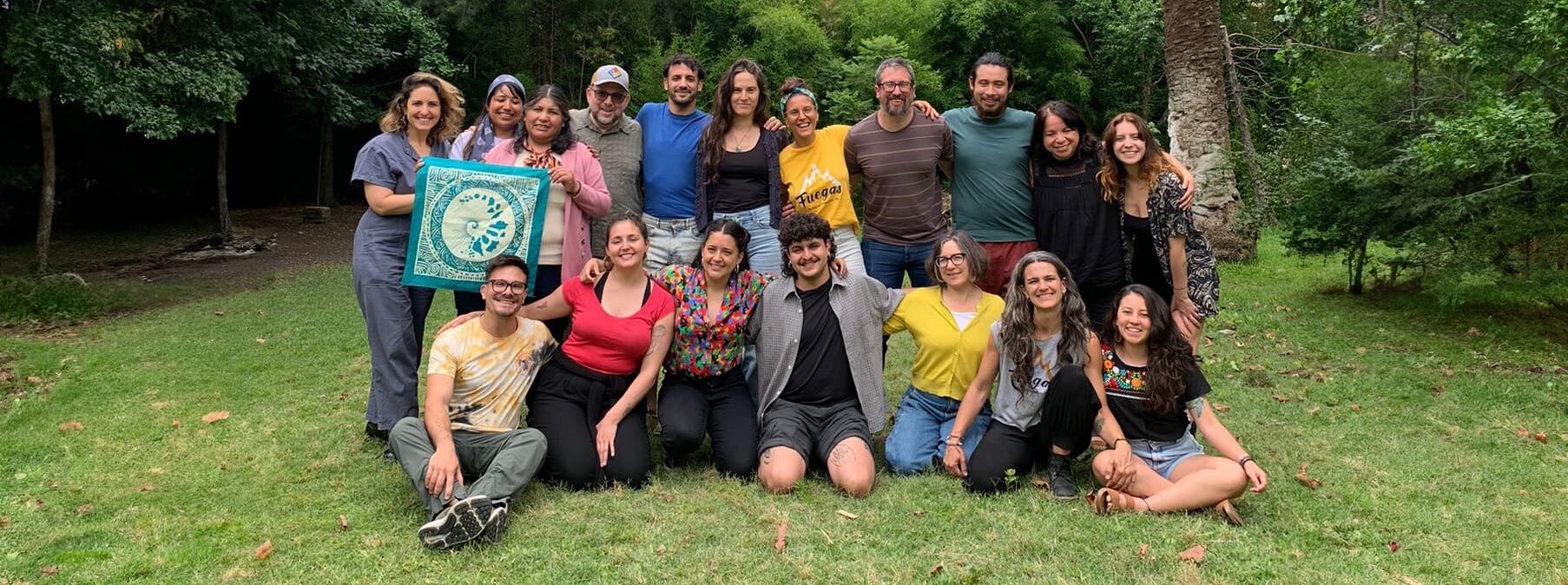
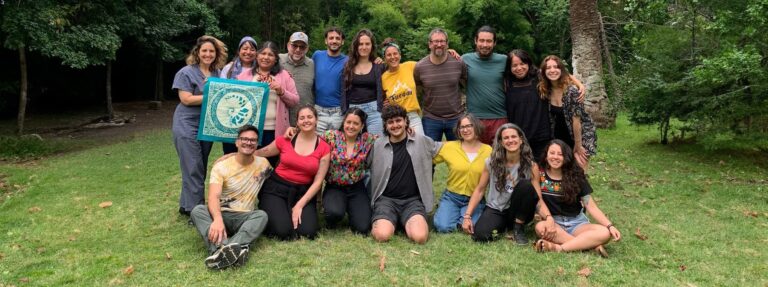
The ORA Community is made up of a group of people who have had the ability to transform their cosmovisions and understandings of the natural world into action—and vice versa. They have created frameworks, narratives, and structures that respond in a diverse and multifaceted way to the challenges of the polycrisis.
Traditionally, a work of research ends with results and a conclusion. This essay, however, ends with more questions and an irrevocable urge to act. For that reason, we set out to think what frameworks of implementation we can build in order to transform or channel these visions and understandings of the world to turn them into action, and how to make them shareable and alive while preserving their essence as situated notions.
The following ideas are just a few of the many proposals to walk the unfolding paths that have opened up for us after this research. While inspired by specific persons and projects, they are strongly influenced by our own experience with the ORA Community in a broader sense, and by our own backgrounds. They bring forth a concern related to the scalability of the conclusions of this work through frameworks of action. These frameworks must be capable of implementing these visions and understandings of the world without emptying them of their essence. Ultimately, they should make them actionable, shareable, and alive, while preserving the notions, place, and relations from which they emerge.
- Communities of learning. The notion of a community of learning is that of a community in which people share a practice or a concern, and where knowledge is generated through exchange with others. Considering the three-year trajectory with the fellows across Latin America, India, and Africa, ORA could create and promote a space that fosters exchanges between the people that are part of its community. Fellows and researchers have diverse trajectories but shared forms of understanding and common concerns, and ORA has the information and the structure to make connections, enhance learning opportunities and relationships. This community of learning could be organized, for example, in thematic nodes where people can come together around a specific topic or need, depending on what each person has to offer and who needs that. A group of nodes makes a network, which is also an interesting idea to explore considering that support networks are extremely relevant for environmental defenders, especially in regions where their work is risky. This should always remain attentive to the origins of each form of knowledge, its situated nature, and the aspects of it that cannot simply be transferred elsewhere.
- Healing towards the future. Efforts to revert the harm inflicted upon the world are continuous and widespread: conservation and other strategies people attempt to put a stop to or prevent further damage to ecosystems and life. While honest and well-intended, some of these approaches fail to understand the need to create a new world instead of struggling to go back, to reinstate something that took millennia to grow and humankind has been reckless enough to destroy. The world is covered in wounds that need healing, there is no doubt about that. Yet some of the damage is irreversible and this demands understanding that healing also requires producing a new world, where scars will be visible and new ecosystems that can thrive in the current state of the world are being created. The Japanese art of kintsugi illustrates this vision well: The planet is broken in ways that cannot be reversed, but it can still be healed, pieced together, alchemized, to stay beautiful and healthy. These transformations are worth exploring and understanding, and could be a new line of research for teams that have already been working with the ORA Fellows.
- Strengthening exchange, interaction, and synergy between scientific and traditional knowledge. The experience of many fellows shows the power of placing academic, traditional, and practical knowledge in dialogue with the purpose of pursuing change and resilience. Continuing research and strengthening pluralistic knowledge systems is a path that this project has already begun to trace. This could be further pursued and reinforced by asking what communities across the globe are doing, why it works, and under what conditions. There are benefits in multiplicity, in diversity, and in the ways identities are shaped through them.
- Visions of nature in early childhood. Throughout the interviews with the fellows, early childhood emerged—in the majority of cases—as the moment in which the seed of a deep and subjectivizing relationship with nature is sown. Rural upbringings and early relationships with the natural world were repeatedly mentioned as elements that structured both these stories and the participants’ broader visions and relationships with nature. Although there is research showing that experiences with nature in childhood can foster pro-environmental behavior, most of these studies emerge from the Global North. Meanwhile, essays and research grounded mainly in Indigenous thought approach this relationship less as a behavioral variable and more as a condition of existence that shapes subjects, ethics, and worlds. However, there is still little information on how these dynamics operate in countries of the Global South and, more importantly, on how these findings from academic research could translate into the creation of strong, empowering, and genuinely creative—in the strict sense of creating—spaces and educational materials capable of encouraging action. Further research could explore the relationship between early childhood, nature, alongside the creation of educational spaces and resources, including educational content based on the conclusions of this work. This might include, for instance, translating the zine into an illustrated fable adapted to younger audiences.
- Communicating and disseminating this work. This is as simple as finding formal instances for disseminating and presenting the results of this research. The sky is the limit: This might include translating materials-such as the zine, this essay, or the narrative frameworks-into other languages, holding events at education centers, or translating these contents to other formats such as animated videos, children’s books, or podcasts that might address other audiences.
The challenge ahead is to bring together the results from the research teams in order to obtain a broad, global view on where the ORA Community can act today. Our time urges us to build frameworks of action capable of implementing these visions and understandings of the world without emptying them of their essence: to make them actionable, shareable, and alive, while preserving the notions, place, and relations from which they emerge. Arts & culture, technology, and ecology are evidently part of the same universe where some of the most powerful responses to the polycrisis will flourish.
Read the companion ORA Ecology zine here
[ Back to top ]