


This document is a result of the research on ecological narratives to inspire action, made by and for the ORA Community. It draws on several interviews carried out with fellows from Latin America, India, and Africa, who use narrative frameworks in their daily work to address pressing conflicts within their communities and territories. It is intended for people who work through stories—writers, artists, organizers, educators, facilitators, and communicators—who want to renew their frameworks and strive to inspire action in a broader sense. In addition to general guidelines of what elements make compelling and engaging messaging, examples from these conversations are included to provide evidence and inspiration.

The polycrisis seems to be all around us, and yet we often narrate it as something distant, abstract and global. Ecological stories often lose force when they begin too far from lived experience. The use of abstract and conceptual language—climate justice, resilience, sustainability, adaptation—does not always translate into messages and stories that people can make their own.
To inspire action, narratives need to endure over time. Inscribing this kind of shift in perception in the minds and hearts of audiences, requires stories that set a shared value, emotion or identity in motion. A home, a river, a garden or a memory can turn into a spiritual calling, and a way of naming the world that holds relationships within it can turn into a form of care or healing.
What gives stories traction is not simply that they diagnose and describe the extent of harm being done. It is that they reveal a web of relations between people and practice, between care and survival, between the human and the more-than-human. They do not present ecology and environment as detached issues; rather they show them as living actions shaped by labor, identity, ritual, food, kinship, conflict, and the struggle to defend what still holds.
This document holds a series of narrative guidelines directed at storytellers in a broad sense. This includes artists, writers, filmmakers, both from non-fiction and fiction, but also journalists, environmental communicators and researchers. Fact and fiction can speak to each other and often intertwine. These guidelines aim to emphasize which values may resonate most, or how to frame messages for a broader audience, and which elements are more likely to invite action.
Storytelling has the power to engage both reason and emotion in ways that facts alone can’t. It sets the possibility on what world the story makes visible, what kinds of life it renders imaginable, what myths, relations, and values it carries, and whether it expands or narrows the horizon of collective action. Messaging can sharpen a story, but it will hardly replace narrative depth that can inspire action. A message may circulate quickly; but it is the story and narrative what gives its roots, memory, and future pathways.
This distinction matters in ecological communication. Catastrophic messages travel faster than the actions they call for, but they also feed paralysis. Stories that remain trapped in exposing the evils of the world may describe the crisis accurately while still leaving audiences with little sense of what is worth protecting, repairing, or building. Narratives become politically useful when they do more than diagnose collapse: when they enable action, and create the necessary conditions to lead people into ways of acting towards it. When other ways of living feel imaginable and tangible, people are more likely to strive towards them.
Narrative Frameworks

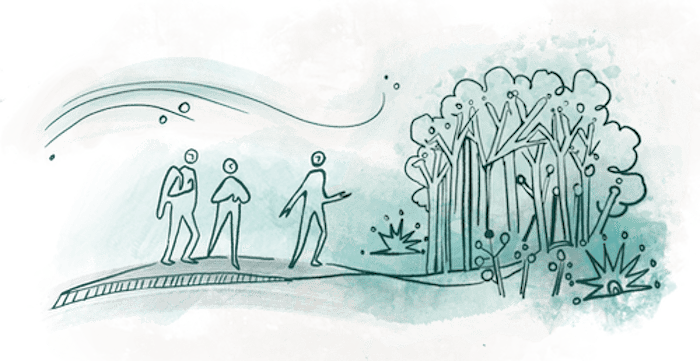
1. Home is where the heart is: the role of the natural world in shaping our sense of place, belonging and identity
Ecology is more compelling when it is not treated as an external and geographically distant “nature out there,” but as the place where life develops and the medium where relationships are formed.
We found that stories are more inspiring when a place is not only presented as a static background. It is not only where our lives thrive, but also the series of living and non-living elements that shape who we are.
For a researcher and storyteller in India, one key to this shift was the word oikos: home. From there, ecology no longer appeared as a technical field or a public issue to be managed from outside. It became the shared home of known and unknown species, and a way of thinking about relations, complexity, and co-existence. That kind of change in perception can transform how much care goes into place. It makes the concepts less abstract and places them inside the world, making actions of care tangible and immediate.
For a researcher in Colombia, the same pattern emerged through the Ovejas River. The river was not merely a water source or an ecological unit. It appeared as a thread of shared memory and existence, something around which elders, children, and families gathered and sustained a sense of community. Through environmental monitoring, shared observation and the defense of territory they are also caring after who they are.
A communicator from West Africa also described how reconnection with earth and territory could begin with a backyard garden and a tomato. Growing vegetables, and food autonomy was also a bridge to experiencing care of land through cultivation. This created an attachment to the Earth prior to any argument or rational discourse.
A river, a mountain, a crop or a landscape are not small details when they are perceived as living beings. Memory adds to the atmosphere. These traits are often what allow a story to become inhabitable. People do not only need to know what is under threat. They need to sense where life is taking place, and why that place matters for the web of life to continue.
2. Story, memory, and myth work as living infrastructure
Stories do more than illustrate ecological values. In many cases, they shape core identity traits and help sustain values that are under the strain of new beliefs.
For an educator in Zimbabwe working with women and youth, folklore and spirituality were not accessory or secondary to ecological understanding. Stories about rivers, deep pools, mountain presences, ancestral spirits, and guardians of water were key when transmitting individual and communal limits, collective responsibility, and forms of care of the land. Spirituality made scientific and climatic knowledge more legible and more actionable than technical discourse learned later in life.
For a community leader in Nigeria, memory itself transformed and constructed ecological methods of subsistence. Cassava is a staple food in the region, but it also holds a lesson about exchange, restraint, and social obligation: if you have cassava, you share it; if a resource feeds the community, you do not simply take everything for yourself. From this emerged a broader ethic of care linked to ubuntu—an ancient African concept that emphasizes that a person is defined through their relationships and community—and to the idea that solutions are rooted in interdependence rather than isolated survival. Here, the story was not ornamental: it carried instruction.
Scientific, academic and institutional storytelling often strips away precisely these rooted and subjective dimensions in the name of objectivity and universality. Yet many narratives endure because they embody inherited knowledge: ritual, taboo, warning, kinship, repetition, cadence, and other forms of culture that do not fit neatly into explanatory objectivity.
The goal is not to romanticize myth or memory. It is to recognize when there is an opportunity in the cultural backdrop to empower their narrative work—holding together a worldview, encoding responsibility, or making visible a relation that would otherwise disappear.

3. Care, stewardship, and participation move people further than disaster
Ecological narratives become more mobilizing when they show people tending, restoring, monitoring, feeding, teaching, sharing, or defending together. Care is a key element in compelling narratives and stories: it does not appear as softness, but rather as social practice, collective labor, and a way of sustaining life under pressure.
For a Nigerian political organizer, this took the form of communal life: sharing food, protecting trees, and recalling solutions based on local knowledge that predated top-down interventions. For a Colombian researcher, community monitoring of the Ovejas River became powerful not only thanks to the information it produced, but because it made participation real. Families, children, elders, scientists, and community members became involved and joined scientific practice with ancestral memory as they gathered around the river and observed together. For a West African communicator, care is a part of practices that belong to daily domestic life: gardening, growing food. Its narrative power drew from its tangibility and its lack of abstraction when referring to this food sovereignty.
These examples point to an important shift: crisis matters, but it rarely carries a story very far on its own. Narratives stimulate change and action when they show how care reorganizes relationships. They also move when the audience is addressed as a potential steward, witness, neighbour, and participant. Care gives people a role that exceeds that of a mere spectator of irrevocable disaster: it tells them where they stand, and what they can do.
4. More-than-human relations, multiple ways of knowing, and ecological imagination can build bigger stories
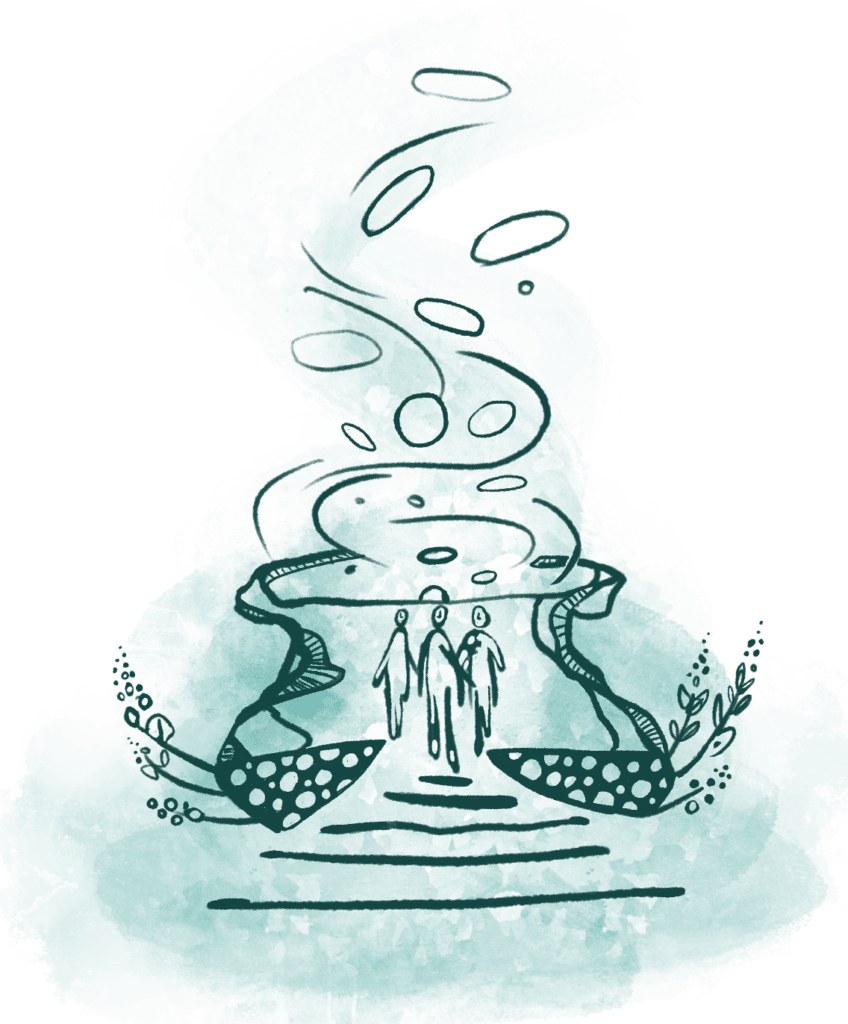
Many of the strongest ecological narratives abandon the idea that only one kind of knowledge exists. They bring together what dominant storytelling often keeps apart: scientific and ancestral, technical and spiritual, cultural and emotional, observational and affective, communal and experimental. This gives way to ecological and multidimensional understanding and ethics of care.
For a researcher in Colombia, community environmental monitoring does not stand in opposition to science: it is a way of joining scientific methods with inherited Indigenous knowledge and with the needs of a community. For a storyteller in India, the notion of ecological relations opened up questions of complexity, relation, and home for multiple species, not only for human management. For an educator in Zimbabwe, befriending scientific and ancestral knowledge allowed him to narrate rivers and mountains through spiritual guardianship while preserving their material aspects. For an organizer in Nigeria, ancestral ecological knowledge offered much more than nostalgia: it provided stepping stones for surviving floods, drought, and social fragmentation.
While these seem to be a diverse assortment of stories, they all refuse to reduce ecology to a technical matter. These stories expand who and what have agency and what forms of intelligence matter. It is not a stylistic choice: it effectively reshapes what kind of futures become imaginable.
Strong ecological narratives do not only add more facts. They alter perceptions. They make it harder to sustain the illusion that humans stand apart from the rest of life, or that institutional expertise is the only source of authority. Stories grow more memorable and alive when they reveal relationships instead of isolating categories.
Do / Avoid / Try
What follows is a set of practical cues to support narrative work that draw on the insights and experiences shared above. Rather than fixed rules, these are loose guidelines—tips and prompts—that aim to shape stories that resonate more deeply and inspire ecological action. They seek to support narratives that invite action, meaning, and a sense of possibility in your audience.
DO
Start from a place, a relation, or something at stake before introducing more abstract concepts. A river, a garden, a crop, a household task, a path, a spring of water—these make the story inhabitable before it becomes analytical. This does not mean abandoning context or scale. It means giving the story a living threshold. Once the reader is inside a world, the larger ecological and political concepts, such as climate justice or environmental crisis can unfold with more strength.
Let care appear in the form of labor, practice, and structure. Treating notions of care as concrete actions means telling what it actually consists of (also interspecies care!). Sometimes it may look like protecting what nurtures a community, cleaning a river together, sharing food, passing down ecological instruction, tending land, observing species, or establishing limits around use and extraction. But care is not an emotional coating, or only a feeling, to make our stories and lives gentler. It is the very form through which survival, belonging, and collective action can be organized.
Invoke existing elements of memory, culture, inheritance when they are doing narrative work. Identity is composed of many ingredients. If a story is being carried through tales, folklore, ritual or culture, make it visible. The core of many successful narratives is to connect with who people are. Removing those layers too quickly in order to sound universal or global can flatten the potential of narratives and weaken its power. A living narrative often recognizes differences, and nuances, to bring them closer together.
Uncover the hidden ecology that is braided with everyday life. The strongest stories do not isolate ecology and the natural world from daily life. Food, labor, spirituality, education, gender, conflict, or identity are woven together with fauna, flora, environment. Ecological relations are already embedded in daily life: sometimes all it takes is naming them and making them visible. It helps to recognise ecological questions are not separate from people’s living conditions, memories and imaginations.
Use scenes, images, and gestures people can remember. People often carry an emotion longer than information. A cassava root that remembers shared moments, the taste of tomato grown in a backyard garden, the joy of a river that gathers a community, a mountain or water body where birthdays or marriages were held are not only examples. They condense shared lifetimes and worldviews. They give the narrative grip to broader senses of place and ecology.
Act with care, whatever the message. Imbuing care for nature can result from actions and contents that seem to be distant to the natural world or the crises we want to overcome. Care as a value needs strong roots: the way to tend to them is to understand the soil being sown. If a community or group is already engaged with an idea, cause or problem, understanding their concern and addressing the issue is likely to foster positive reactions and permeability to new ideas. Acting with care—or love, tenderness, solidarity—when working on other aspects of a community’s life, can transcend to invoking care for a place and actions to protect it.
AVOID
Do not externalize ecology. Don’t push it away geographically or socially. When ecology is framed only as “the environment,” it often sounds distant, uninhabited by human life (which sadly is many times the only valued kind of life by many), and detached from the ordinary. It seems to be something that exists in many people’s lives only when they are on holiday. A resonant story rejects this distance and presents ecology as home, care, continuity, food and life. The further away the issue, the harder it becomes for people to locate themselves inside it.
Do not flatten communities into narrative devices. Communities, projects and endeavors of resistance are not merely examples or characters for your story. It is crucial to be careful when narrating their contradictions, tensions, or conflicts and what that exposes for the community. When a story turns people into clean symbols—heroes, victims, keepers of timeless truth—it may become easier to package, but less faithful to life. Complexity is not a weakness. Often it is the source of narrative truthfulness.
Do not strip out spirituality, myth, or inherited meaning to make your story seem universal. Find ways to explain specific nuances rather than avoiding them. It is often the case that these dimensions are not an anecdote, they are central to how specific communities and their ecological relations are understood, remembered, and acted upon. Removing them can separate the story from its own complexity. Some narratives lose force when every image is decoded and every ambiguity resolved. Clarity matters. Over-translation does not. The challenge is not to exoticize them, but to narrate them, understanding them, when they are carrying ethical, practical, and emotional meaning that cannot simply be replaced by technical language. Perhaps the only way to truly understand this, is to get closer emotional to the people and the community, and try to draw from your first person experience
Do not force your own wishes and hopes into realities that are collective, unfinished, or contradictory. Not every story moves in a linear fashion, from problem to solution. Some move through repetition, return, fracture, or long internal conflict. Some hold uncertainty as part of their truth. Imposing an overly polished story can make the whole narrative or piece feel artificial or false. Be faithful to the true life of the material, especially when the story is about survival, relation, or slow collective struggle.
TRY
Try asking yourself what the story proposes and what kind of action it inspires, not only what it denounces. This small shift can transform the entire potential of narratives. A story centered only on harm may communicate urgency, but a story that also shows what forms of life, memory, relation, or possibility are being defended often becomes more memorable and more politically generative. It gives the audience something to attach to, not just something to fear.
Try locating the forms of care already present in daily life. Before adding an external moral frame on individual actions, try understanding how we got there and where care is already happening. Caring can mean people grow, share, teach, notice, tend, observe, monitor, repair, reuse or remember. Already existing practices can become the spine of the story. They empower and inspire action without relying on external heroes.
Try explaining what a local word, metaphor, or relation means when translation would flatten it.
Not everything needs to be converted immediately into institutional vocabulary. Sometimes a term, a rhythm, or a form of relation keeps the narrative alive precisely because it resists complete equivalence. Precision sometimes means staying close to the form in which meaning is carried.
Try testing what the story provokes. Does this story bring about more desire to action? At the end of drafting a message, it helps to ask one difficult question: does this piece only describe what is broken, or does it also make another way of acting more thinkable? Storytelling in the midst of the polycrisis grows stronger when it envisions what can be done around desirable futures, not only when it grows out of danger or consciousness. A narrative travels further when people can spread their world vision with it.
Read the companion ORA Ecology zine here
Read the companion essay “Understandings of Nature that Nurture Holistic Action” here