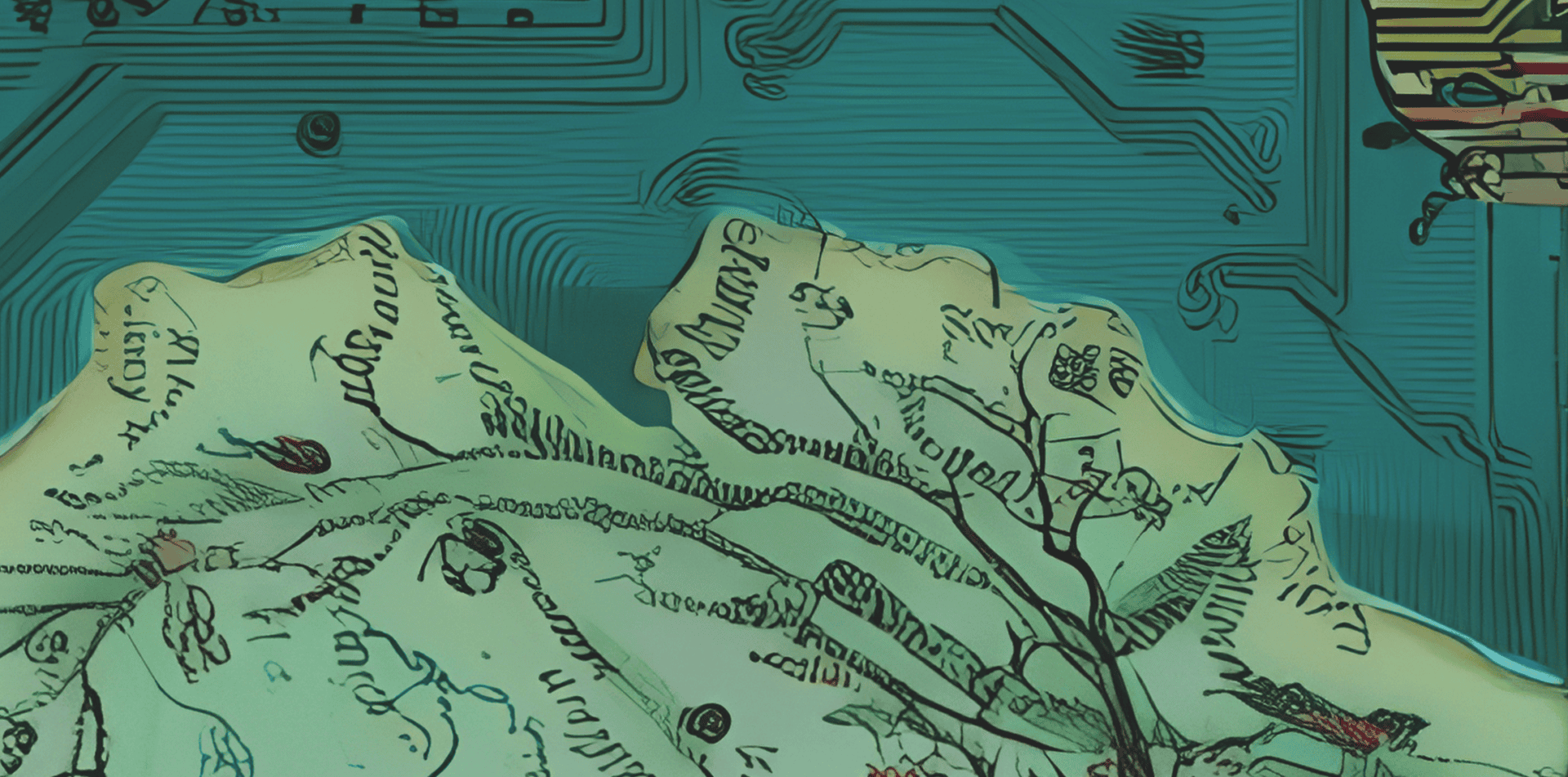
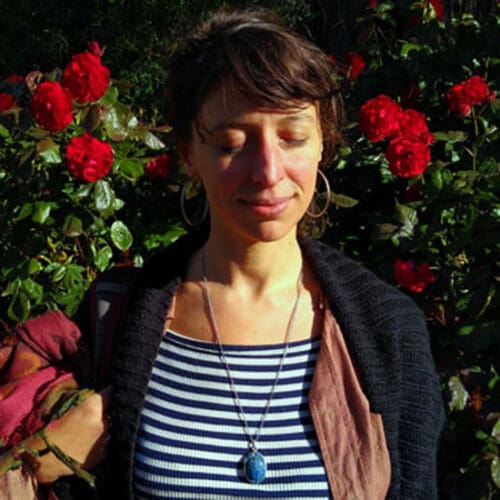
This blog is a logbook and space for poetic reflection on Entangled Horizons: Collective Speculations for Gentle Futures, a project led by ORA Latin America Fellow, researcher, poet, and philosopher Gabriela Klier and her collaborators.
Entangled Horizons emerged from Proyecto RUMIA, a collective that draws on biology, philosophy, and the arts to imagine ways of living and dying together. Guided in part by the work of biologist and philosopher Donna Haraway, the project asks what narratives, images, and dreams might contribute to worlds that are more just and more livable — “worlds where many worlds fit,” as the Zapatista motto says. The project has evolved into a research, outreach, and creation project rooted in Bariloche, Patagonia, bringing together scientists, artists, educators, indigenous communities, and activists to collectively speculate toward gentler, multispecies, and decolonial futures.’
To be able to imagine, wounds must be healed
recognize the pain — the memories of the land
the inheritances of colonial violence
the wounds of silence
to be able to imagine we must listen to other voices
the poet Claudia Masin calls us together: we build from the wound —
poetry is a reparative gesture.
Where to Begin?
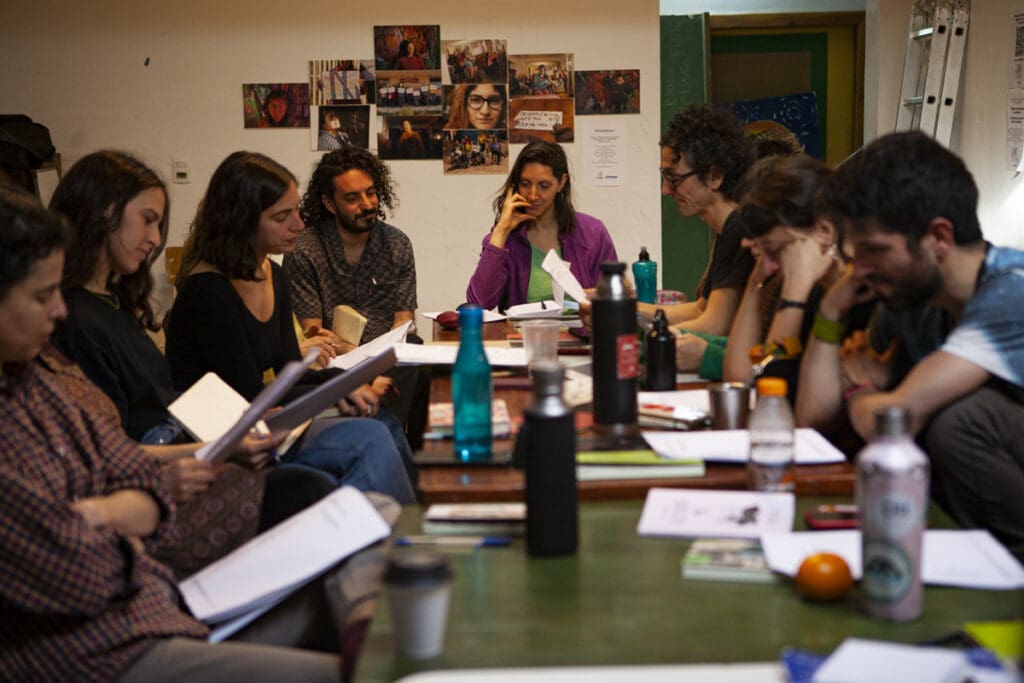
As Entangled Horizons emerged, we began with a challenge: what kinds of gatherings allow us to think together? What practices open up new weavings of thought and relation?
We believed the arts could bring people from different spheres together outside the rigid discourses that lock us into disciplines and institutions. We needed sensory experiences to unlock other imaginaries. As Diego Sztulwark puts it, when the world of ideas becomes a desert, what we need are other affects.
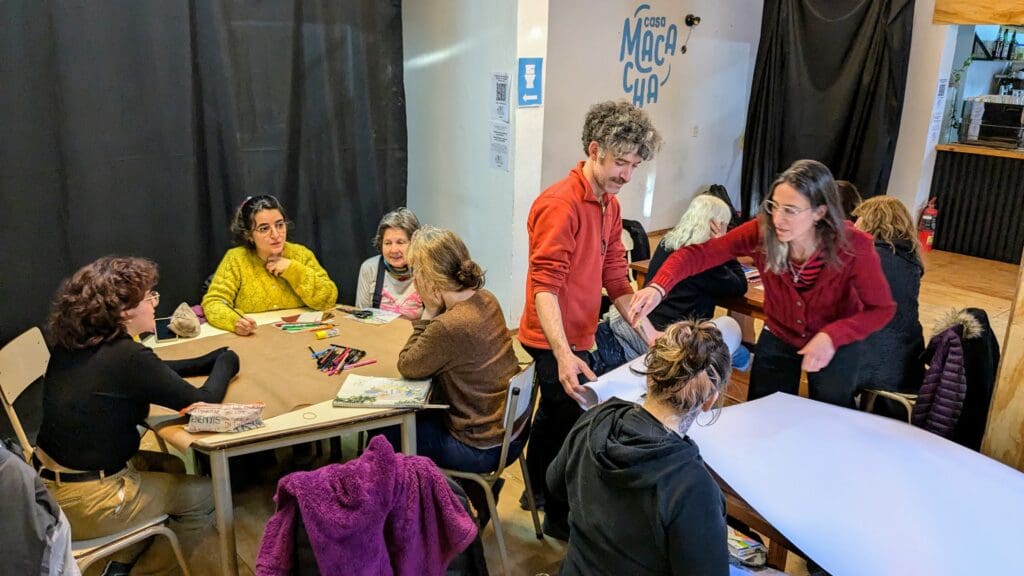
So we organized workshops and encounters at Casa Macacha, a local cultural center, opening participation to the general public and inviting facilitators from across different fields. The National University of Río Negro joined as the project unfolded. Throughout, we prioritized in-person gatherings in our city, rooted in specific territories over the broader but more disconnected reach of virtual formats.
The Place Beneath The Project
Bariloche is a mountain city in Northern Patagonia, a transitional space between forest and dry, grassy plain. If you search for a photo, Google will likely return mountains and a blue lake on sunny days, with snow and people in immaculate ski jackets. Bariloche is all of that and everything else: it is marginalized neighborhoods, floods, fires, corruption and real estate speculation, people who came from large cities, yellow broom (as invasive as it is beautiful) in November, the noise of construction, and school graduation trips.
Bariloche is the birthplace of Argentina’s first national park in the 1920s, a site of state territorialization with its buildings and brute forces. It is the place from which, on an island in the middle of Lake Nahuel Huapi, someone attempted to make an “encyclopedia” of trees by planting species from around the world, and from which pine trees went out to “Europeanize” this nature. It is also home to the first atomic research center, public universities, and the Bariloche Foundation, where in the 1960s people dreamed of a Latin American, sovereign science.
Bariloche is today the city with the highest density of scientists and technologists relative to its population.
Bariloche is Furilofche — “the people from behind the mountain” in the Mapuche language — it is also a territory of memory and colonization, a site of indigenous genocide. In the middle of the civic center stands a statue of Julio A. Roca, a monument to what was called the “conquest of the desert” — that deceptive name given by those who murdered and displaced local indigenous communities. At every demonstration (feminist, environmentalist, for human rights, for public education), Roca and his horse are decorated: green scarves for the legalization of abortion, gas masks rejecting nuclear power plants, white handkerchiefs like those of the Mothers of Plaza de Mayo. In the past year the mayor decided to fence it in. Even so, the monument continues to be decorated.
Our Findings
Entangled Horizons asks about futures in a place of overlapping times and spaces. From that question, we formed a working group and opened a call for workshops, talks, and encounters — exploring poetics that might enable other ways of living. These included workshops on future cartographies, science fiction, the poetry of small things, porous bodies, and infinite theater; a children’s workshop on water ecologies in Colonia Suiza; public talks on water, money, and philosophy; and a party called “Do Robots Dream of Electric Parties?” that used Spinozian joy as a tool for thinking futures together. A closing residency was planned, but the fires of summer 2025 arrived uninvited and transformed it into solidarity work for those affected. Faced with these disasters, imagining other futures becomes ever more urgent.
Below are reflections from these workshops and events:
The map is not the territory, but it orients us.
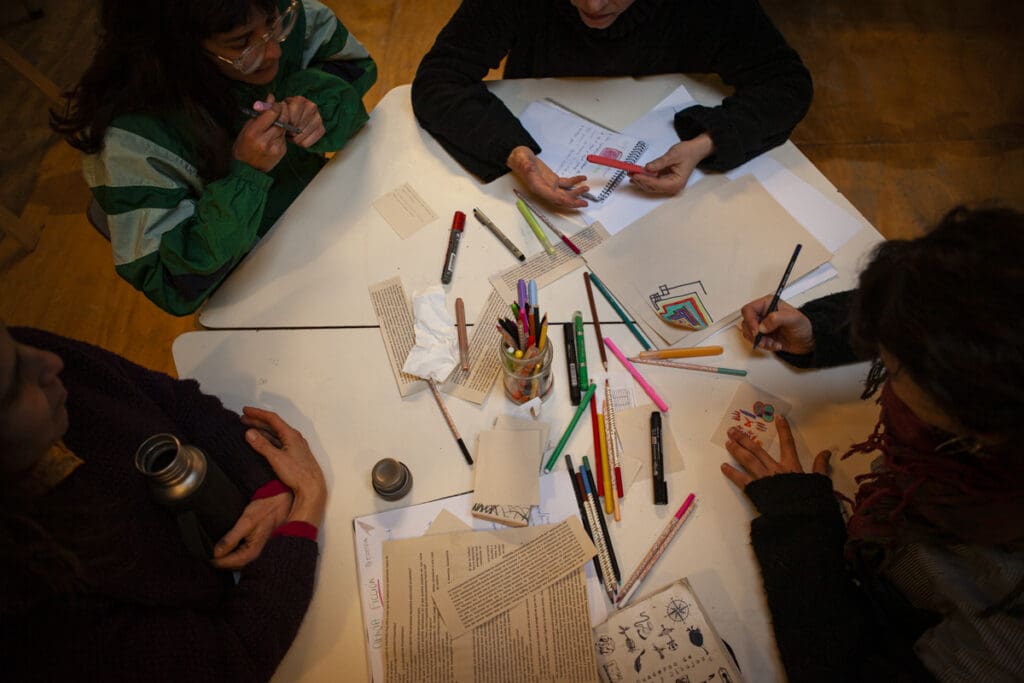
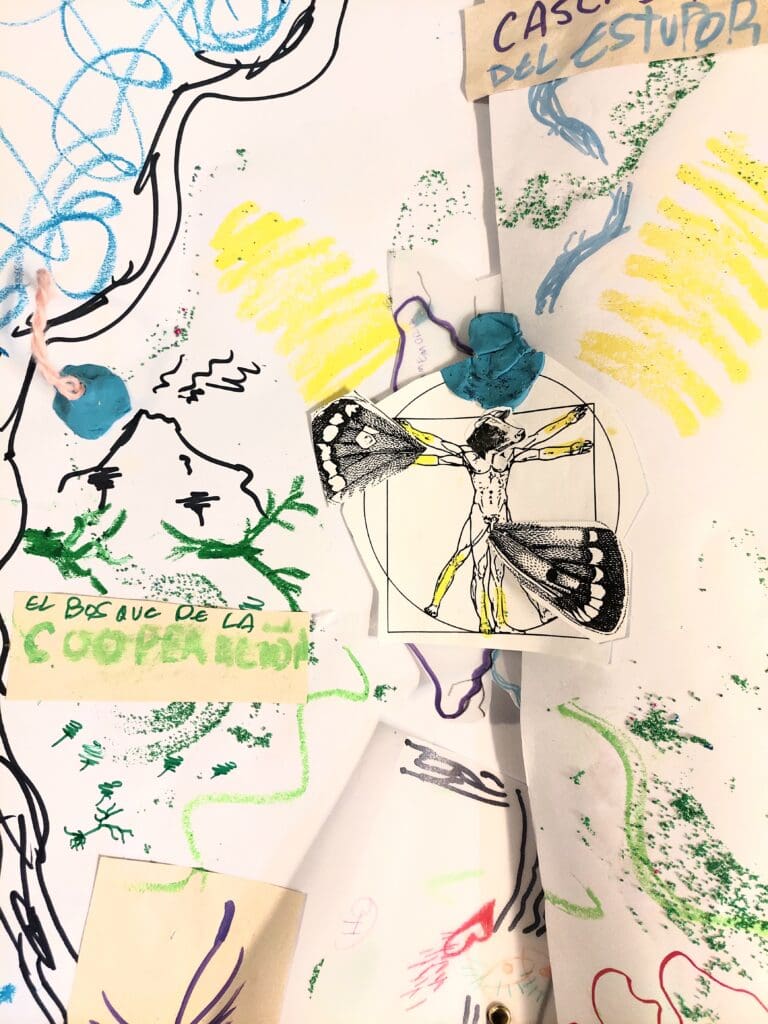
To map futures, we need dialogue and shared agreements. Working with tactile materials opened up new ways of thinking: in the folding of a single sheet of paper, past, present, and future become entangled. The physical and material has the power to unsettle fixed ideas, and in that unsettling, other ways of thinking become possible. We also found that gathering allows us to step outside the “stupor of the present” and find other rhythms that make collectivity possible.
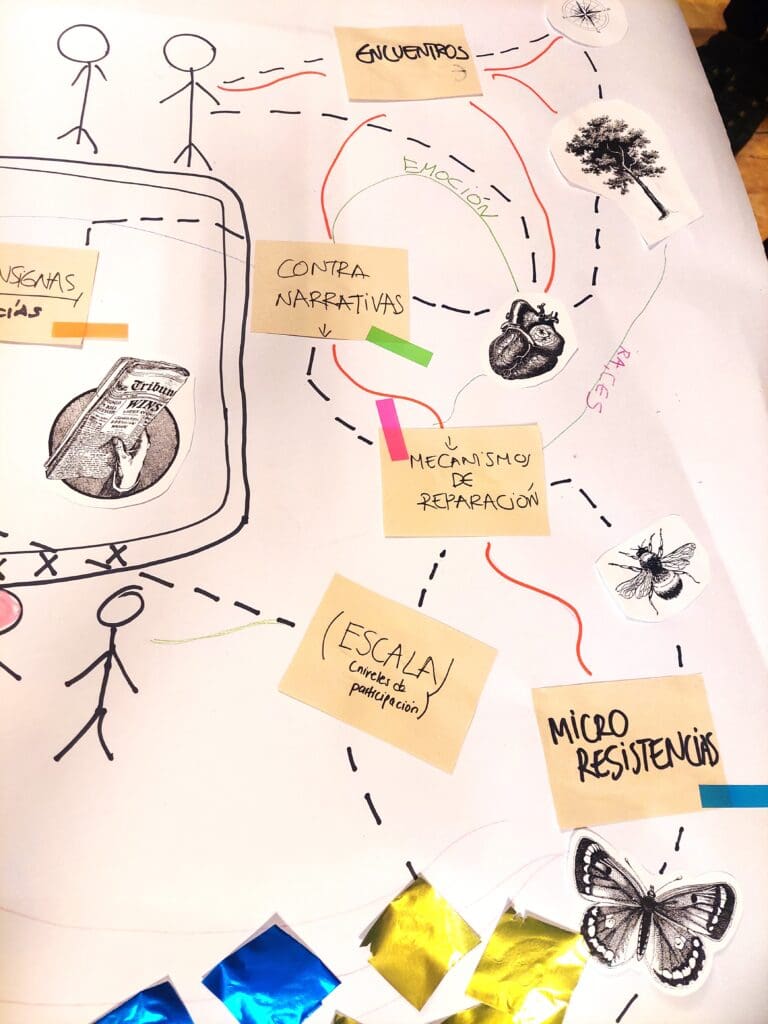
“The future is a community pot”
The precariousness of existence brings us closer together, opening up other networks of support. We assemble and disassemble in community, moving through uncertainty together. One of the maps drawn of a gentle future declared it simply: “the future is a community pot” — a place with other ways of making family, with cats and friendships, skies and rivers, bugs and fungi, and strange encounters.
Beauty
A rabbi recounted the story of two women who survive Auschwitz because they know that at one moment each day they will see each other and hold hands. That small joy sustains life. In Kabbalah, tiferet is beauty — and the tradition holds that strength lies in finding those small flashes of it, even in the theater of horror. Moving through grief — through genocides, fires, and the advance of violence — spaces of beauty give us air, a sustenance to keep going. The collective resists because it is the sustenance of life. And life resists.
Resilience
In ecology, resilience is the capacity to return to an original state after a disturbance. But perhaps there is no longer an original state to return to. Perhaps resilience is something else: a capacity for creative regeneration — for rebuilding worlds that are not preserved or identical to what came before, but gentle and joyful. A capacity to confront and honor the pain of the world while cultivating small practices of care, and imaginaries of justice and love — for the land, for each other, for the many beings we share life with.
The small
After Lola Halfon’s workshop “Buzzing Closer to the Flowers,” Marisa Bilder wrote: “The future is a present / always small / where I wait for the bird.” Minor gestures and small acts of care sustain us. As the poet Diana Bellesi said: “the small is no less than the great and nothing remains or is final — abandon the shell of fear toward the simple shadow of mystery.” In the small, there are worlds to discover: spores that will germinate once the storms have passed.
Invention
The future is plural — they are futures. To imagine is to imagine ourselves alongside other beings: plants, animals, fungi. Speculative practices allow us to look beyond capitalist realism toward other possible worlds. Even useless practices can be composted, transformed into something regenerative. To stop, to meet, to share — to sow small images that will sprout in unexpected places — is itself a form of resistance. There are other gentle worlds to explore and shape together.
the futures are plural
Poem by Gabriela Klier
the futures are plural / also present
they sprout among the rubble
like wild plants
/ a volcano in eruption reminded me:
we are a very small animal
in the middle of infinite storms /
the futures are plural / they are also pasts
even within each family there are different ways
of looking back: each gaze is a landscape
and time
tangles and interweaves
and is never a line
the futures are intentions
intensities
chaotic entanglements of affections and desires
the futures ask for pauses
the futures ask for gestures
the futures are present desire
the futures sprout from the cracks of memory
memory asks for repair.
About the Author
Gabriela Klier is a researcher, poet, and philosopher based in Bariloche, Argentina, and an ORA Latin America 2024 Fellow. A CONICET researcher at the National University of Río Negro, she explores the poetics, affects, and ethical questions that shape environmental research in Northern Patagonia—bridging art, science, philosophy, and socio-environmental activism. She collaborates on projects including Proyecto RUMIA, Collective Thinking, Mushroom Week, and LENTO, an art-science festival, and teaches across formal and community settings. She is the author of two poetry collections: Biología and Las Muertes, las Casas y las Bestias.
The following were part of the project: Constanza Casalderrey, Teo Bonilla, Matías Graffigna, Juan Pablo Restrepo, Sofía Nemenmann, Tati Hernández, and Laura Borsellino.
The following participated as guests and workshop facilitators: Ezequiel Gatto, Diego Singer, Lola Halfon, Francesca Giordano, Alejo Di Risio, Bar Visconti, Librenauta, and Francisco Rivarola.