In Uttarakhand (India), a community radio station opens its doors, creating a spacious commons where multivocal knowledge flows across the community.
In Cameroon, a photographer turns his lens on refugees, challenging narratives that reduce them to victimhood alone.
In Argentina, a body-territory map is pinned to a clinic wall so that no physician can deny the relation between poisoned lands and sick bodies.
Elsewhere, someone sings, someone listens, and someone records what others insist is not there.
Across pláticas with Commonweal’s Omega Resilience Awards (ORA) fellows in Africa, India, and Latin America, one lesson emerged with unusual clarity: culture itself is a terrain of struggle, where meaning is contested and power made visible. Cultural work is not simply representation; it is a way to remember what has been erased, reclaim narrative power, and widen spaces to imagine otherwise.
Time and again, ORA fellows described their work as pushing against institutionalized narratives that diminish, flatten, or erase entire peoples, places, and ways of knowing.
“No single person has a monopoly on knowledge or ideas.” — Sungu Oyoo
For Kenyan writer, educator, and activist Sungu Oyoo, violence begins in the realm of knowledge itself. Colonial domination reduced centuries of African cosmologies and knowledge traditions to myth, folklore, and superstition. These hierarchies of knowledge are not symbolic; they become material in the seizure of land, organized abandonment of communities, and uneven distribution of injury and survival. He turns to Pan-Africanism as a way of reclaiming anti-imperialist, anti-capitalist, and feminist traditions to bring new worlds into being.
Dalit trans activist Chandini from Karnataka, India names an insidious violence: the exclusion of trans lives from school curricula. What is left out of the syllabus is left out of social recognition. In teaching children what matters, schools also teach them whom not to see.
Burundian photographer Emery Ndayizeye, working with refugees in Cameroon, confronts a different, although equally dangerous narrative: the dominant humanitarian narrative that construes refugees through a monochromatic lens of vulnerability and victimhood, as if displacement strips people of complexity. Emery uses audiovisual storytelling to insist on the vibrancy of refugee life: people creating, thinking, improvising, surviving, and refusing reduction.
Placed side by side, these stories reveal something fundamental: domination relies on flattening people to categories, landscapes to empty space, and knowledge to only those forms legible to institutional power.
Counterstorytelling is the powerful cultural work of restoring complexity to lives, places, memory, and ways of knowing.
Working alongside Adivasi communities and state forest guards in India’s conservation landscapes, ORA fellow Raza Kazmi has witnessed how those fighting for land and survival are often reduced to binary symbols of resistance or victimhood. Raza insists on complex stories and storytelling as a form of material solidarity. These are the narratives that honor the full scope of their humanity, including the parts that are contradictory, ordinary, flawed, or unheroic. This is what Mohammed El-Kurd identifies in his critique of the “perfect victim”: solidarities so conditional on legibility that they disintegrate when the story becomes harder to hold.
Counterstorytelling, at its most rigorous, refuses the terms that make solidarity conditional. It rejects the demand that oppressed people appear only as heroes or victims in order to be seen. In unsettling those dominant frames, it opens the possibility of learning otherwise—not only by telling different stories, but by shifting who gets to teach, testify, and produce knowledge.
ORA fellow Nakul Singh Sawhney enacts this in film and media. He founded ChalChitra Abhiyaan to build a network of storytellers, reporters, and filmmakers from marginalized communities across caste, class, and religion in rural North India; thus, shifting not just what stories are told, but who holds the authority to tell them.
In Argentina, this reconfiguration of knowledge takes concrete form in the work of physician and professor Damián Verzenassi. Alongside fellow medical students, he helped create a free professorship in which social movement workers entered the classroom not as case studies, but as educators. Communities had long been speaking about the health effects of agrotoxins, GMOs, pollution, and mega-mining, but professionalized medicine had simply failed to listen. Verzenassi’s intervention did more than introduce new content. It altered the terms of recognition through which knowledge and learning materialize.
“It is about life as we live it.” — Rajendra Negi
Community media activist Rajendra Negi co-founded Henvalvani, a community radio in Tehri Garhwal, India, which enacts a similar practice of co-learning. Here, community radio is not an unidirectional medium of transmission but a commons: a shared infrastructure of learning where community knowledge travels across many directions, voices, households, generations, and forms of expression.
To narrate from within the community is also to make visible the broader structures that condition everyday life.
Chilean theatre artist Evaluna Valdivieso Segura names those structures through an ecofeminist lens. She sees capitalism and patriarchy operating through a shared logic that treats feminized bodies and the Earth as spaces of conquest, control, and extraction. Her theater cooperative resists that logic not only through its public performances, but in its very ethos: building a collective ethic of care that is constitutive of the work itself.
“No one, really no one in the world, gets by alone.” —Evaluna Seguar
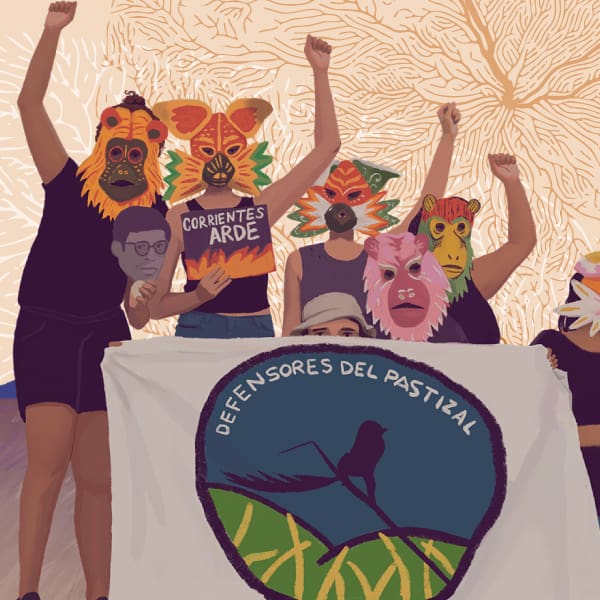
Argentinian biology teacher Dulcinea Lezcano encountered a related lesson in Corrientes. When her team’s early interviews were dominated by men’s voices, she shifted from individual interviews to knowledge circles convened by trusted local interlocutors. That methodological change transformed the archive: women, teenagers, and elders began to speak, bringing a different account of the territory into view.
The grasslands of Corrientes, described by the state and forestry industry as “empty” and “unproductive,” emerged instead as inhabited lands gradually enclosed by subsidized pine and eucalyptus plantations that drained groundwater, disrupted phone signals, and drove families away. Here, official discourse functions as a logic of dispossession, recasting people’s lands and lifeworlds as “empty” so that enclosure by state and industry can appear as policy rather than violence. Lezcano’s documentary does not simply represent these communities, it connects them. By weaving together multiple voices, it becomes a node in a broader network of resistance, circulating among affected territories and forging solidarity through shared recognition.
Adrienne Maree Brown’s concept of fractals is useful here. The same structures of extraction and erasure recur across scale, as do practices of resistance, recognition, and solidarity. Looking at ORA fellows’ work collectively makes those patterns visible. Each struggle is shaped by a larger system, and each act of connection helps generate the collective power needed to transform it.
If cultural work names harm and builds connection, it also changes our sense of time.
As Chandini and Evaluna Segura’s work shows us, the modality of theatre can hold past, present, and futurity together, all at once. Chandini’s play Talki is based on the memories and experiences of trans people in Bangalore, performed by actors all above the age of fifty. Here, the everyday becomes an archive of trans people’s struggle, survival, dignity, and pride.
In Segura’s Proyecto Andes, a future of water scarcity is staged to bring the present into sharp relief. It is a reminder that the crisis is not a future event. It is already here, unevenly distributed, determining which lives are expendable. Theater makes that simultaneity felt. It demands that we endure the in-between — the slow dissolution of what was, and the uncertain emergence of what might be.
For Kenyan performing artist Mwongela Kamencu, breaking the linearity of time takes the form of ancestry as obligation. In Meru cosmology, the dead remain in eternal relation to the living — a belief that carries ethical weight. If those who came before us continue to care for the world, then the living must tend it for those yet to come. His song Kileleni (Top of the Hill) brings this enmeshed futurity into view.
Dulcinea Lezcano finds herself returning to folkloristic chamamé whose lyrics recall the beauty of the grasslands as it used to be. This is not nostalgia, but a way of listening for what has long been woven into cultural practices—a reminder of one’s rootedness in the land and of the responsibility to defend it for futurity.
“I am where I believe I need to be, giving and doing what I can from where I am.” — Dulcinea Lezcano
Dispossession is not only material. It also robs people of the capacity to imagine otherwise. Cultural work, and especially performance arts, sustains the radical imaginaries that keep political work oriented not merely against what must be undone, but toward what has not yet been made possible.
In a time that presses relentlessly toward fragmentation and despair, ORA fellows across continents and contexts offer us something sturdier than optimism or hope. They show that the future is not foreclosed. Cultural memory is a resource for struggle – a way of carrying what remains, grieving what is lost, and refusing to act as if the future is foretold.
Cultural work is where people name what is happening to them, recognize themselves as subjects of history, and collectively rehearse the worlds they are working to build. They insist we are here, and the story is not over.
Return, then, to the opening scenes of this essay. The photograph, map, radio station, testimony: each is a concrete act of refusing erasure and making collective life more imaginable, more possible.